

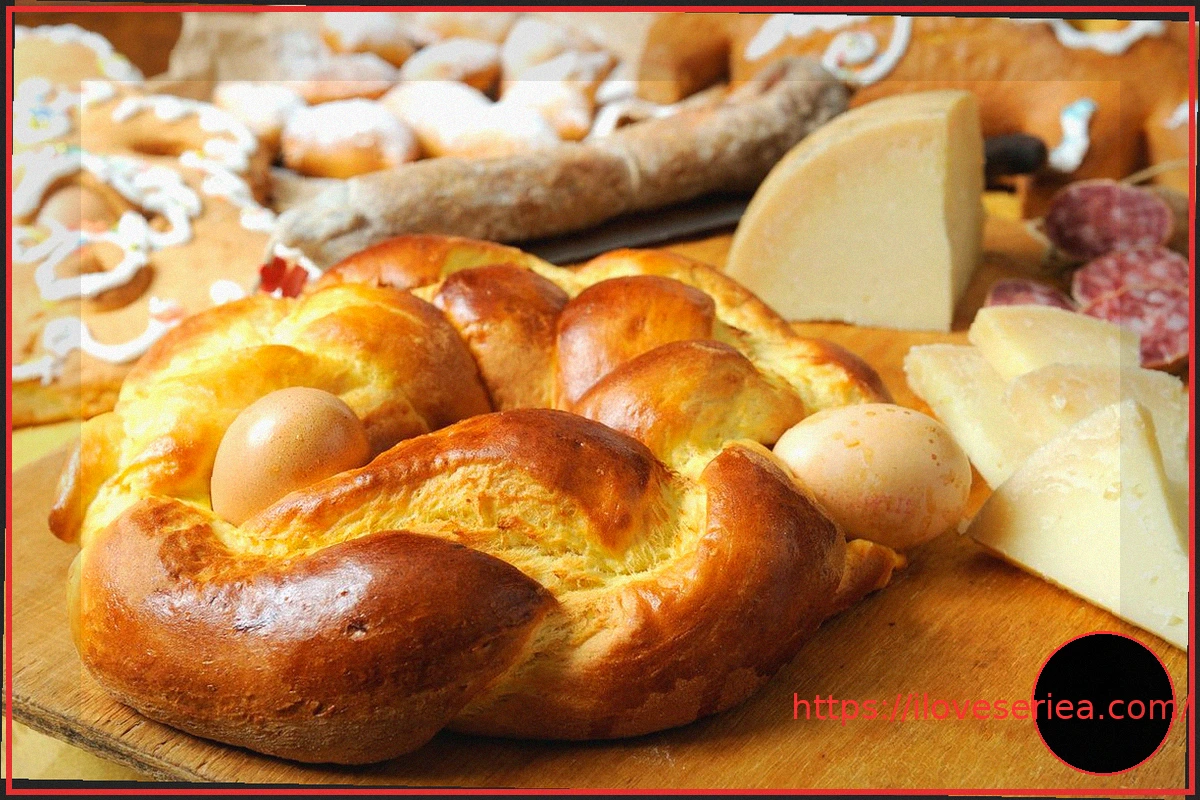

Easter Bread, or “Pane di Pasqua,” is a traditional recipe from Southern Italy, often enjoyed for breakfast or lunch on this festive holiday. Today, we delve into this typical Easter leavened bread, which boasts numerous variations. We must preface our recipe by acknowledging that every family prepares it uniquely. Some enrich the dough with cured meats and cheeses, akin to a savory tortano, while others keep it plain, decorating the surface with whole eggs.
It’s worth noting that even the shape varies widely. We’ve chosen the braided crown, which most symbolically represents this holiday. What distinguishes Easter Bread from other leavened goods is the inclusion of eggs and butter in the dough (though some use oil). The flours typically consist of a blend of soft wheat and semolina, but you can certainly use only soft wheat flour.
Easter Bread is commonly savored for holiday breakfast alongside hard-boiled eggs, cured meats, and cheeses, but it can also grace the lunch table, serving almost as a beautiful centerpiece. Its preparation falls into a broad category of traditional Easter breads and leavened products that define Italian regional cuisine. Examples include Crescia di Pasqua from Marche and Umbria, Neapolitan Pizza Chiena, Roman Torta al Formaggio and Pizza Ricresciuta, and the list continues up the boot, reaching Emilia Romagna with Pagnotta Pasquale and Veneto with Fugassa.

Ingredients
For the Easter Bread
- Re-milled durum wheat semolina – 100 g
- “00” Flour – 400 g
- Whole milk – 250 ml
- Honey – 1 teaspoon
- Granulated sugar – 50 g
- Fresh brewer’s yeast – 6 g
- Egg – 1
- Butter – 70 g
- Fine salt – 1 teaspoon
For brushing
- Egg – 1
- Milk – 2 tablespoons
For decorating
- Eggs – 4
Preparation
Easter Bread
- Pour the lukewarm milk into a bowl and dissolve the yeast, honey, and sugar, stirring with a wooden spoon. Let the mixture rest for 10 minutes.
- Then incorporate the egg and mix well.
- Add the flour, and once the dough begins to form, incorporate the salt.
- When all the flour has been absorbed, but before the dough fully forms a smooth ball, add the room-temperature butter and continue kneading until it is completely incorporated.
- Allow the dough to rise in a bowl covered with plastic wrap until it doubles in volume.
- Next, divide the dough into three equal parts and form strands approximately 30 cm long. Braid them together, then shape into a ring and transfer to a baking sheet lined with parchment paper.
- Place the whole eggs on the surface, gently nestling them into the dough, and let it rise again for a couple of hours or until doubled in size.
- Whisk the remaining egg with the milk and use this mixture to brush the entire surface of the bread.
- Bake in an oven preheated to 180°C (350°F) for 35-40 minutes, ensuring it is thoroughly cooked before removing from the oven.
As you may have observed, this recipe shares similarities with many other typical Easter preparations across Italy. Personalization is encouraged, as each family often has its unique way of preparing it – and that’s part of its charm!
Storage
You can store the bread for approximately 2-3 days in a cool, dry place, ideally in a bread bag to maintain its softness. Freezing is not recommended.