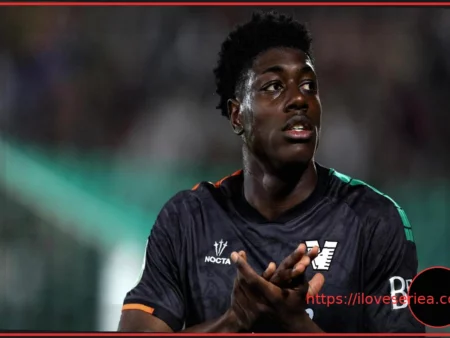


The unthinkable has indeed become reality once more. The Italian national football team has, for the third time in a row, failed to qualify for the FIFA World Cup.
After the traumatic experiences of 2018 and 2022, the Azzurri will conspicuously be absent from the 2026 tournament across North America, following a heartbreaking playoff defeat against Bosnia and Herzegovina in Zenica.
For a nation that views the World Cup as its inherent domain, a twelve-year hiatus from the sport’s grandest spectacle transcends mere crisis; it represents a historic catastrophe.
Gattuso’s Emotional Response to Playoff Heartbreak
A visibly shaken Gennaro Gattuso addressed the media moments after the final whistle, finding it difficult to express the “deep pain” engulfing the squad.
Despite playing most of the match with ten men after Alessandro Bastoni received a red card in the first half, Italy valiantly fought to a 1-1 draw over 120 minutes.
Nevertheless, the unpredictable nature of a penalty shootout once again sealed Italy’s fate, as they lost 4-1 with crucial misses from Francesco Pio Esposito and Bryan Cristante.
“It hurts, it truly hurts,” Gattuso conveyed to reporters, his voice heavy with emotion. “I have absolutely no interest in discussing my future today. Our focus should be on Italy, on the blue jersey, and the grim reality that this is yet another monumental setback for our footballing movement. I personally extend my apologies to all Italians. I failed to deliver, and it deeply pains me to witness this group of players, who gave their absolute all, suffer in this manner.”
Gattuso’s Future: FIGC President Gravina Extends Support Amidst Crisis
Despite widespread demands for a complete overhaul of the Italian football system, FIGC President Gabriele Gravina has unexpectedly voiced his support for the beleaguered manager.
In the direct aftermath of the Zenica catastrophe, Gravina affirmed that he has requested Gattuso to retain his position and spearhead the team’s transition towards Euro 2028.
“I have asked Gennaro to stay, and I have also asked Gianluigi Buffon to remain in his role,” Gravina declared.
While the FIGC board is scheduled to convene next week to deliberate on the “profound crisis,” the federation appears reluctant to dismiss a manager who only assumed the role from Luciano Spalletti last June.
A Lost Generation: Italy’s Persistent World Cup Curse
The statistics paint a grim picture. Italy now holds the unenviable record as the first former World Cup winner to miss three consecutive tournaments.
By the time the 2030 World Cup commences, it will have been a staggering 16 years since Italy last participated in a knockout match in the competition (dating back to the 2006 final).
This failure is particularly bitter, considering the emergence of promising young talents such as Francesco Pio Esposito and Tommaso Baldanzi, whom many had hoped would finally break the “playoff curse.”
Instead, Italy now joins a growing list of significant absentees for the expanded 2026 tournament, leaving fans and pundits alike pondering when the Nazionale will eventually reclaim its rightful place at the pinnacle of global football.
The Road Ahead for the Azzurri
The immediate focus for the Azzurri now shifts to the UEFA Nations League and the arduous path towards Euro 2028. For Gattuso, the impending challenge will be as much psychological as it is tactical.
Rebuilding the shattered confidence of a squad that has now endured this ultimate sporting trauma three times will demand the “Grinta” (grit) for which he was renowned as a player. However, it remains uncertain whether the fanbase will possess the patience to support him through this daunting task.